How to Build a Travel SEO Content Calendar Around Booking Seasons

The travel agency that publishes a “summer Europe tours” guide in June is doing SEO wrong. Not because the content is bad, because it is 4 months too late to rank before the bookings happen.
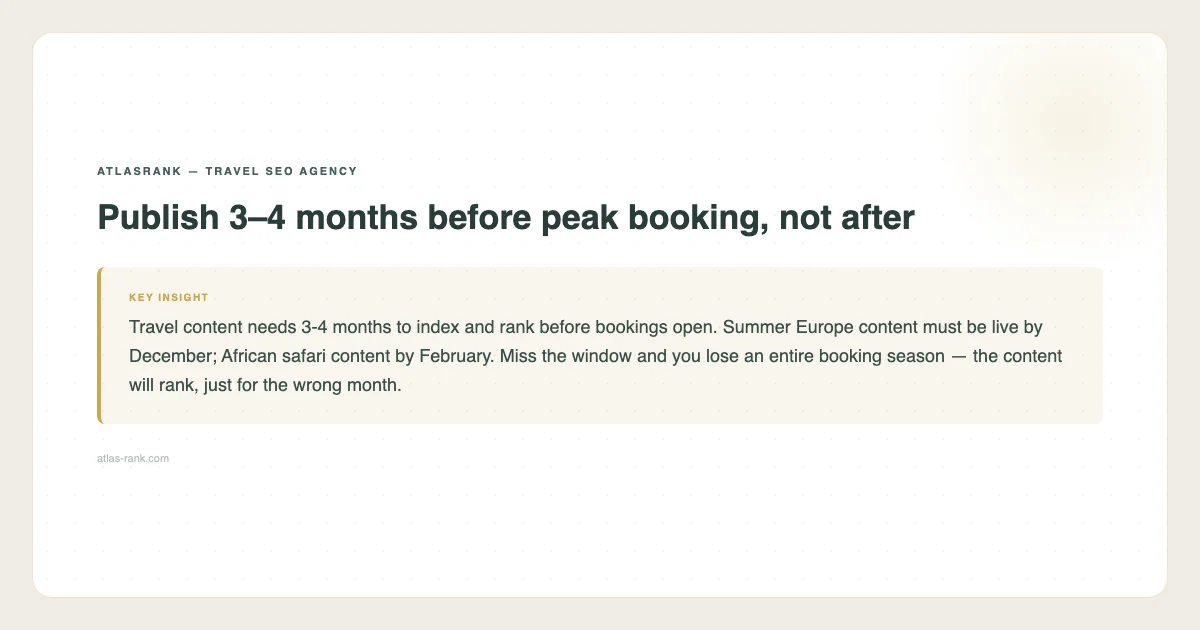
Travel SEO is governed by a timing principle that most agencies miss: the gap between publishing and ranking is 4-12 weeks. If your buyers book summer travel in March and April, content published in March cannot rank in time to capture those bookings. It has to be live by November or December.
This is the content calendar principle. Not just “publish consistently” but publish the right content in the right month for the right booking season.
Why timing matters in travel SEO

SEO content takes 4-12 weeks to rank after publication. Publishing in November for summer bookings is too late to appear on page 1 in time for the peak booking window.
This is different from most industries. A B2B software company can publish a comparison post in January and see booking leads in March. The buying cycle is year-round. Travel has hard seasonal cycles. A family booking a summer Italy trip in March will search in January. Your content has to already be on page 1 when they search.
The compounding factor: content that ranks for one summer keeps ranking. Year two, it appears earlier in the season with a stronger position. By year three, a well-maintained seasonal guide is on page 1 from November through May without new investment. The opportunity cost of publishing late is not just this season. It is every future season where that piece would have been ranking.
The travel booking season calendar
Different travel niches have different booking peaks. Map your content calendar to the booking behaviour, not the travel dates.
Summer Europe (June-August travel):
- Peak booking: February-April
- Publish content: November-January
- Key queries: destination guides, itinerary posts, experience-specific pages
Ski season (December-March travel):
- Peak booking: September-November
- Publish content: June-August
- Key queries: ski resort comparison, off-piste guides, family ski packages
Cherry blossom Japan (March-April travel):
- Peak booking: November-January
- Publish content: August-October
- Key queries: Japan tour operators, Tokyo and Kyoto itineraries, blossom timing guides
Maldives dry season (November-April travel):
- Peak booking: June-September
- Publish content: March-June
- Key queries: Maldives luxury resort comparison, liveaboard operators, snorkelling guides
African safari high season (June-October travel):
- Peak booking: January-April
- Publish content: October-January
- Key queries: Kenya/Tanzania safari operators, Big Five guides, family safari planning
This is the same content calendar framework a travel seo agency uses when onboarding a new travel client: front-load authority content 3-4 months before peak, then maintain cadence.
How to build a 12-month travel SEO content calendar
Step 1: Identify your 3 peak booking windows. For most travel agencies, there are 2-3 distinct booking seasons that generate the majority of revenue. List them.
Step 2: Work backwards 3-4 months from each booking peak. That is when your content must be live and ranking. For summer bookings in March, your content must be published by November.
Step 3: Assign content types to each publishing window. Three types work best:
Destination experience pages (primary ranking targets): “Small-group Tuscany wine tour 7 days” are your money pages. They need 1,200+ words, FAQ schema, and internal links to your booking pages. Publish 2-3 per booking season.
How-to and planning guides (cluster support): “How to plan a first-time Morocco trip,” “What to pack for a Namibia overland tour” support the destination pages, build topical authority, and capture early-funnel searchers. Publish 1-2 per month in the build-up period.
Comparison and FAQ posts (AEO-focused): “Morocco vs Egypt: which destination is right for first-timers?” and “How long should a Kenya safari be?” capture “People also ask” queries and are the most likely to appear in AI Overviews. Publish 1-2 per month throughout the year.
Step 4: Fill in the calendar. 12 months, publishing windows mapped, content types assigned. Aim for 2 posts per month minimum. In months 1-3 after launch, 4 posts per month accelerates topical depth and speeds up rankings.
How many posts do you need per month?
Two posts per month sustains topical authority for most travel niches. More posts in the first 3 months accelerates cluster depth and helps the primary destination pages rank faster.
The reasoning: Google ranks pages partly based on the topical authority of the surrounding site. A site with 20 deeply interconnected pages on Morocco travel outranks a site with 3 Morocco pages, all else equal. Publishing 4 posts per month for the first 3 months builds that cluster faster than publishing 2.
After month 3: drop to 2 posts per month for maintenance. Quality matters more than volume at that stage.
The complete travel SEO guide covers the keyword tier framework and how to sequence content by KD score, which informs what to publish in each window.
What content types work best in travel SEO
Not all content ranks equally in travel. Based on performance across destination niches:
Destination experience guides (1,200-2,000 words): highest-ranking content type. Specific experience plus destination plus FAQ schema. Ranks for long-tail queries, converts at high rates.
Itinerary posts (900-1,500 words): “7 Days in Jordan: The Exact Route” captures planning-stage searches. High sharing rate. Good for brand awareness and backlinks.
Comparison posts (800-1,200 words): “Morocco Desert Tour: Guided vs Self-Drive” captures decision-stage queries. High commercial intent.
Seasonal timing posts (600-900 words): “Best Time to Visit Iceland” is informational with high AI Overview exposure, but strong for brand citation if AEO-structured correctly.
FAQ and planning posts (600-800 words): “What to Pack for a 2-Week Vietnam Trip” captures early funnel, easy to produce, builds cluster density.
One content type to avoid: generic “top 10 destinations” posts with no experience-specific angle. These compete with travel media sites that have DA scores of 80+. You will not rank for them. Use the word count on a specific destination guide instead.
If you want your content calendar planned and executed for you, contact AtlasRank. That is the first deliverable we produce in month 1.