AI Overviews Are Killing Travel Organic Traffic: What To Do About It

If you track organic traffic for a travel site, you have probably seen it. A query that used to send 200 visitors a month now sends 40. The ranking position hasn’t changed. Something above the results has.
That something is a Google AI Overview. Google generates a direct answer to the query, displays it at the top of the results page, and a significant portion of users read it and leave without clicking. No visit. No booking. No revenue.
This is not a future concern. It is happening now on informational travel queries across the board.
Here is what travel agencies need to know, and what you can do about it.
What is a Google AI Overview and why does it matter for travel?

A Google AI Overview is a machine-generated summary that appears above organic search results for certain queries. It pulls from multiple web pages, synthesises an answer, and presents it directly on the search results page.
For travel, the queries that trigger AI Overviews most often are:
- “best time to visit [destination]”
- “how long is a [destination] tour”
- “what is [country] travel like for first-timers”
- “visa requirements [country]”
- “how to get from [city A] to [city B]”
These are exactly the informational queries travel agencies have spent years ranking for. Top-of-funnel content that was driving awareness and first-touch attribution is now being answered without the click.
If you are working with a travel seo agency right now, AEO should be part of the brief. FAQ schema and answer-first content structure should be standard, not optional.
Which travel queries are most affected by AI Overviews?
Informational queries are the most exposed. If the intent is to learn something, AI Overviews answer it. If the intent is to buy or book something, they don’t.
High exposure (informational intent):
- “best time to visit Costa Rica” (AI answers with months, weather pattern, brief explanation)
- “how long does a Morocco desert tour take” (AI answers with duration ranges)
- “is solo travel in Vietnam safe” (AI answers with safety overview)
Low exposure (commercial intent):
- “Morocco small group tour operator”
- “book luxury safari Tanzania”
- “travel agency Portugal tours 2026”
The implication for strategy: don’t panic about your full content library. Audit by intent. Informational content needs AEO restructuring. Commercial content (service pages, product pages, experience-specific landing pages) is mostly fine and may actually gain from competitors who are pulling back on informational content.
The AEO response: how to get cited inside an AI Overview
Being cited inside an AI Overview is not guaranteed. But it is achievable. Here is what Google’s AI is pulling from when it generates a travel Overview:
FAQ schema: Pages marked up with FAQPage schema give Google machine-readable Q&A pairs. These are ideal input for AI Overview generation. If you have FAQ sections on your pages without schema markup, add it. It is the single highest-leverage AEO change you can make.
Direct answer blocks under 40 words: Structure each section so the first 1-2 sentences answer the implied question directly. “The best time to visit Morocco is October to April, when temperatures range from 18-26°C and rainfall is minimal” is an ideal AI-citable answer. Then expand with context below it.
Question-first H2 headings: “When is the best time to visit Morocco?” outperforms “Morocco Climate Guide” for AI citation because it matches the query structure directly.
Topical authority across the niche: AI Overviews cite sources that have established authority on the topic, not single pages with one good post. Build out your destination niche with multiple interconnected pages.
How to restructure existing travel content for AEO
You don’t need to rewrite everything. A targeted restructure of your top informational pages will have the most impact.
Practical checklist per page:
-
Add an answer block in the first 100 words. Rewrite the opening paragraph to answer the primary question directly. If the page is “Best time to visit Santorini,” the first sentence should state the answer, not build up to it.
-
Add a FAQ section with 3-5 questions. Use questions your target audience actually asks. “What is the weather like in Santorini in September?” beats “Santorini weather overview.”
-
Add FAQPage schema to the FAQ section. If you are on Astro, WordPress, or any CMS, there are schema plugins and code snippets that handle this. It takes 20 minutes per page.
-
Shorten answer blocks. If your existing answers are 100-word paragraphs, trim to 40 words. Put the elaboration below the answer block, not in it.
-
Check heading structure. Change statement headings to question headings where it makes sense.
For the full AEO framework and how it connects to ranking strategy, the complete travel SEO guide covers this in detail.
Does AEO mean giving up on organic clicks?
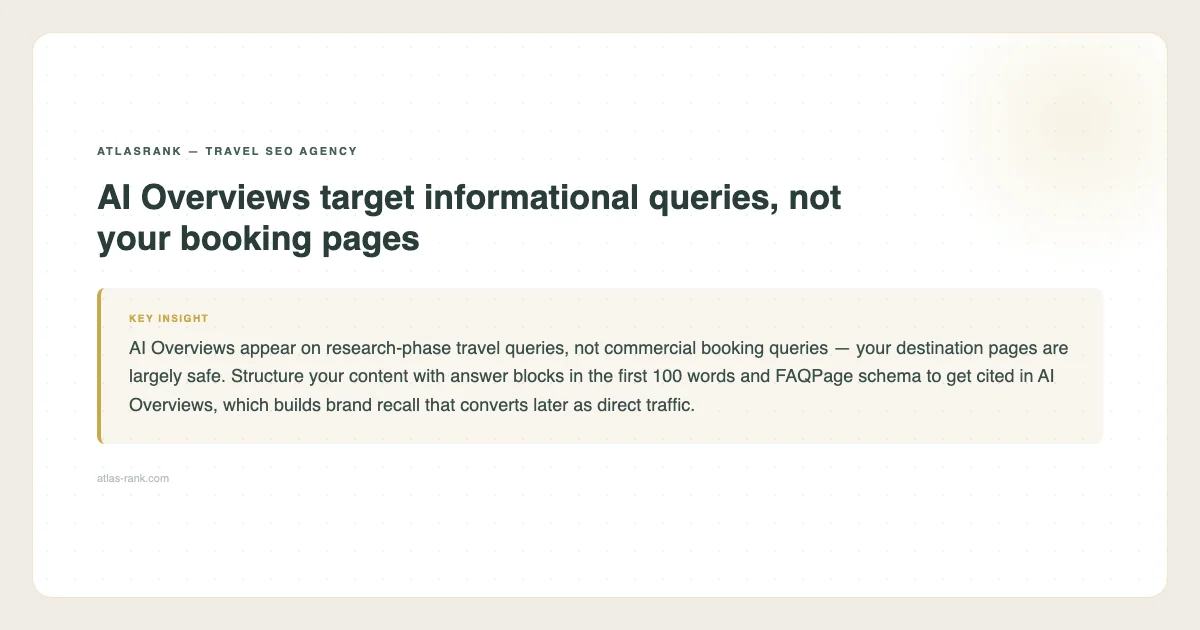
No. AEO citation still drives traffic, just differently. A citation in an AI Overview puts your agency name in front of the user even when they don’t click. They search for you directly later, convert as a direct visit, and you get the booking without the attribution.
Beyond brand awareness, not all travel queries trigger AI Overviews. Commercial and experience-specific queries still drive direct clicks. The agencies who restructure now for AEO and continue producing commercial-intent content will outperform the ones who do nothing.
The ones who are pulling back on content investment because “AI is taking all the traffic” are ceding topical authority they have spent years building. Don’t be those agencies.
One thing worth noting: AI Overview citations currently do not have a clean attribution path in GA4. You will not see “AI Overview referral” in your sources. Monitor your branded direct traffic. That is where a significant proportion of AI-assisted conversions land.